You're in the 6%: What AI-Free CRM Is Costing Your Business
Ninety-four percent of marketing teams now use some form of AI in their workflows.
2026-06-06
You're in the 6%: What AI-Free CRM Is Costing Your Business
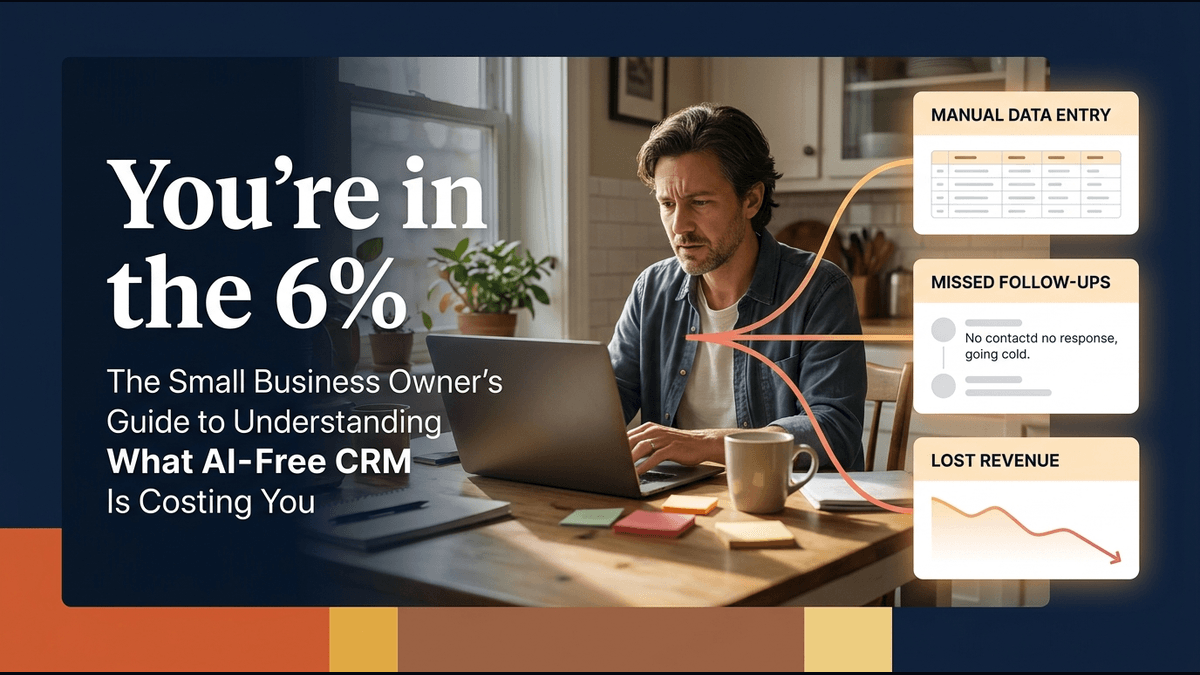
Ninety-four percent of marketing teams now use some form of AI[1] in their workflows. That means if you're still running your CRM on manual follow-ups, copy-pasted email templates, and a mental to-do list, you're not just behind the curve. You're in a structural minority that's paying a real, compounding price for it. Not a vague, theoretical price. A dollar-and-hours price that shows up every single week.
This article is for the 6%. Not to shame them, but to show them exactly what the gap costs, and what closing it actually looks like in practice.
The Four Leaks You Don't Know You Have
Most small business owners who haven't adopted AI in their CRM don't think of themselves as falling behind. They think of themselves as busy. And they're right. They're buried in the day-to-day, which is exactly why the leaks are so hard to see. But they're there, and they're running simultaneously.
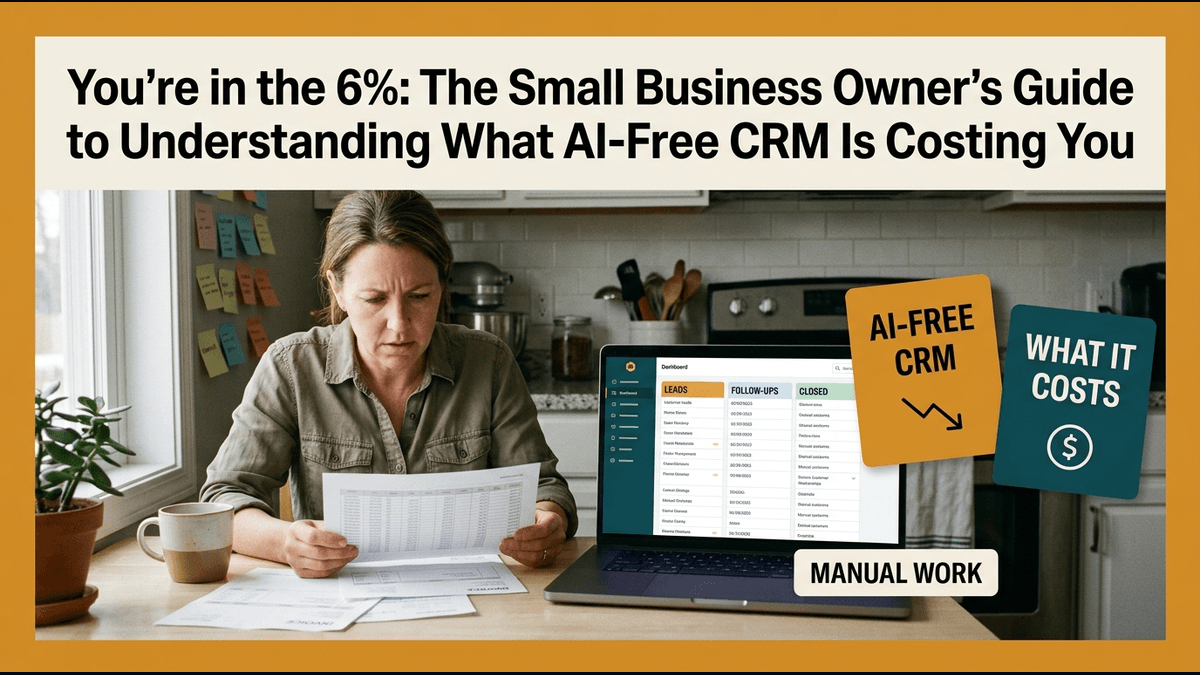
The first leak is lost leads. A prospect fills out your contact form at 2pm on a Tuesday. You're on a job, in a meeting, or just heads-down. You see it at 6pm. You reply the next morning. By then, they've already booked with someone who responded in under an hour. That's not a hypothetical. It's a pattern that plays out across thousands of small businesses every day. Competitors using AI-assisted reply workflows are simply faster, and in most markets, the first responder wins the deal.
The second leak is wasted labor hours. Creating content for six channels, email, blog, Instagram, LinkedIn, Facebook[2], and your Google Business Profile, manually takes somewhere between 15 and 25 hours a week for a small team doing it right. Most small businesses aren't doing it right. They're doing it inconsistently, which creates a third leak: brand voice erosion. And the fourth? Your content isn't structured in a way that AI search engines can find, cite, or recommend. More on that in a moment.
What "Slow to Respond" Actually Costs You Annually
Here's a calculation worth doing with your own numbers. Say you get 20 inbound leads per month. Research consistently shows that slow follow-up, anything beyond a few hours, costs businesses roughly 30% of those leads to faster competitors. That's six leads per month walking out the door before you even had a real conversation.
Now multiply six leads by your average deal value. If you're a consultant closing $2,500 projects, that's $15,000 a month in pipeline that evaporates because of response lag. Annualized, you're looking at $180,000 in potential revenue that never made it to a proposal. For a realtor, an insurance agent, or a B2B service provider, the numbers get larger fast.
The uncomfortable truth is that this isn't a sales problem or a staffing problem. It's a workflow problem. AI-assisted CRM tools can draft and send an on-brand acknowledgment, offer a booking link, and route the lead to the right follow-up sequence within minutes of the inquiry, without you touching it. The technology exists. The question is whether you're using it.
The Hours You're Spending That You Shouldn't Be
Content creation is where the time drain is most visible and most fixable. A typical small business owner or marketing coordinator spends somewhere between three and five hours producing a single week's worth of social content, and that's before writing the email newsletter, updating the blog, or drafting the follow-up sequence for last month's leads.
That math doesn't work at scale. And it especially doesn't work when the output is inconsistent. Monday's LinkedIn post sounds like you. Thursday's Instagram caption sounds like it was written by a committee. The email that went out last Tuesday read like a press release. Your audience notices, even if they can't articulate why they're less engaged than they used to be.
The practical alternative isn't hiring a content team. Most SMBs can't afford one. It's building a workflow where your CRM data feeds an AI system that already knows your voice, your tone, and your audience. One that drafts content you can review and approve in minutes, not hours. The goal isn't to remove you from the process. It's to remove the parts of the process that don't require you.
Brand Voice Debt: The Compound Interest Nobody Talks About
There's a concept in software development called technical debt, the accumulated cost of shortcuts taken early that make everything harder later. Brand voice debt works the same way. Every generic email your CRM sends, every off-brand social post, every "Dear Valued Customer" that goes out under your name is a small withdrawal from the trust account you've spent years building.
The problem with generic AI output isn't that it's wrong. It's that it's interchangeable. A prospect who gets a follow-up email that reads like it came from any of your competitors has no reason to feel a connection to you specifically. And in service businesses, where the relationship often is the product, that's a serious liability.
This is why the "just use ChatGPT" approach has a ceiling. A general-purpose AI tool doesn't know that you always open with a question, that you never use corporate jargon, that your clients are busy professionals who want the point in the first sentence. It produces content that sounds like AI. Your brand voice is a competitive asset. Protecting it while scaling content output is the actual challenge, and it's one that requires a system built for it, not a workaround.
AI Search Is Changing Who Gets Found and Who Doesn't
Here's a shift that most small business owners haven't fully processed yet. When someone asks ChatGPT, Google's AI Overview, or Perplexity a question like "Who's the best insurance agent in Alpharetta?" or "What should I look for in a business consultant?", those tools don't search the web the way Google did in 2018. They pull from content that's structured, authoritative, and consistently published under a recognizable brand.
If your CRM isn't feeding a regular content workflow, blog posts, FAQs, email sequences that get forwarded, social content that gets saved, you're invisible to those systems. Your competitor who publishes a 600-word FAQ post every week is getting cited. You're not. That gap compounds over time in a way that's genuinely hard to reverse once it's established.
The businesses that will own AI search results in their local markets over the next two years are the ones publishing consistent, on-brand, structured content right now. Not the ones with the biggest budgets. The ones with the best workflows.
What Closing the Gap Actually Looks Like
Closing the AI gap in your CRM doesn't require a six-month implementation or a dedicated tech hire. The businesses doing this well tend to follow a simple pattern:
- They identify one or two recurring CRM interactions, a new lead inquiry, a post-appointment follow-up, a monthly check-in, and build an AI-assisted content workflow around each one.
- They train their AI tool on their actual brand voice: real examples of their best emails, their most-shared posts, the way they talk to clients in person.
- They review and approve every piece of content before it goes out. The AI drafts. The human decides. That approval step is what keeps the output authentic and on-brand.
- They repurpose. One strong CRM interaction, a client question, a common objection, a success story, becomes a blog post, three social captions, and an email subject line. Same source material, six channels, under 30 minutes.
- They measure response time and content consistency as business metrics, not just marketing vanity stats.
The Human-Prompted and Human-Approved™ model matters here. The fear most small business owners have about AI content, that it'll say something wrong, sound robotic, or embarrass them in front of a client, is valid when there's no human in the loop. But when the workflow is built around human review at every output stage, that risk drops dramatically. You're not handing the keys to a machine. You're giving yourself a very fast, very capable first draft.
The Decision You're Actually Making
Not adopting AI in your CRM workflow isn't a neutral position. It's an active choice to operate with slower response times, higher content production costs, inconsistent brand voice, and weakening visibility in AI-driven search. Those aren't hypothetical future risks. They're current, measurable disadvantages that compound every month you wait.
The 94% aren't all doing it perfectly. Plenty of businesses are using AI tools badly, generating generic content, skipping the human review step, treating it as a cost-cutter rather than a quality amplifier. But the ones doing it well are pulling ahead in ways that are increasingly hard to close from behind.
If you're in the 6%, the question worth asking isn't "Should I eventually look into this?" It's "What has waiting already cost me?" Run your own numbers. Leads per month, average deal value, hours spent on content per week. The answer is usually more clarifying than any case study.
If you want to see what a Human-Prompted and Human-Approved™ content workflow looks like in practice, one built around your voice, your CRM, and your actual schedule, Contero.ai is a good place to start.
Frequently Asked Questions
What does it actually cost a small business to not use AI in their CRM?
The costs fall into four categories: lost leads from slow follow-up, wasted hours on manual content creation, brand inconsistency that erodes client trust over time, and reduced visibility in AI-powered search results. For a business with 20 leads per month and a $2,500 average deal value, slow response alone can represent six figures in lost annual revenue.
Won't AI-generated content sound generic and hurt my brand?
It can, if you use a general-purpose tool without training it on your voice and without reviewing the output before it goes out. The risk drops significantly when you use a system built to capture your specific brand voice and when a human approves every piece of content before it's published or sent. The AI drafts. You decide.
How long does it take to set up an AI content workflow for a small business CRM?
Most small businesses can have a basic workflow running in a single session. The setup involves identifying your most common CRM interactions, providing examples of your best existing content so the AI can learn your voice, and building a simple review-and-approve step before anything goes out. The ongoing time investment is typically 30 minutes or less per week once the workflow is established.
Is AI in CRM only useful for large businesses with big marketing teams?
The opposite is closer to the truth. Large businesses have marketing teams that can absorb manual content production. Small businesses don't. AI-assisted CRM workflows are most impactful for solo operators and small teams precisely because they close the gap between what needs to get done and what one or two people can realistically produce in a week.
Sources
- improvado.io (improvado.io)
- upgrad.com (upgrad.com)