The Practical AI Agent Answer for Solopreneur Content
The Practical AI Agent Answer for Solopreneur Content Nearly half of small businesses used AI in some capacity as of the most recent Census-based figures, and content creation topped the list of use…
By Steve Sanford · 2026-07-20

The Practical AI Agent Answer for Solopreneur Content
Nearly half of small businesses used AI in some capacity as of the most recent Census-based figures, and content creation topped the list of use cases [1]. That statistic tells you AI adoption stopped being a novelty a while ago. What it doesn't tell you is why so many of those same business owners still feel like they're drowning in blog drafts, social captions, and email copy every week. The gap between "using AI" and "having a system that actually works" is where most solopreneurs get stuck, and it's the exact gap the AI agent wave is finally built to close.
Everyone's Chasing Speed. That's the Wrong Target
Ask a solopreneur why they started messing with AI tools and you'll hear some version of the same answer: they wanted content faster. Cheaper, too. That instinct isn't wrong, exactly, but it's aimed at the wrong problem. Speed is the obvious thing to chase.
It's also the least interesting lever available right now, because almost everyone already has access to fast. Ninety-one percent of marketing professionals report using AI tools daily, and 93% use them specifically for content. Fast stopped being a differentiator the moment it became universal.
The real bottleneck for a one-person marketing operation isn't output volume. It's whether that output sounds like the same business every time it shows up. A solopreneur juggling six channels doesn't need six drafts by Friday.
They need six posts that a customer could read blind and still recognize as coming from the same brand. That's a voice problem, not a speed problem, and it's the one most AI tools quietly ignore while they compete on how fast they can spit out a paragraph.
What the Data Actually Says About Agentic AI
The agentic AI conversation has moved fast, and the numbers show real momentum. More than half of executives report their organizations have deployed AI agents in production [2]. IDC has flagged generative AI for content creation as the leading SMB AI use case, and its recommendation is specific: point agents at repetitive, high-volume bottleneck work rather than trying to automate everything at once [3].
But here's the number that matters more than the deployment figure. Only 23% of organizations have managed to scale a single agentic AI system enterprise-wide [2]. Deployment is easy. Scaling something that stays reliable, on-brand, and trustworthy over time is a different problem entirely.
That gap isn't a technology failure. It's a governance failure. Most businesses can turn an agent on. Very few have built the guardrails to keep it producing work they'd actually put their name on, month after month.
For a solopreneur, this distinction is everything. You don't have an IT department to babysit a misfiring automation. You need something that works reliably from week one, with a low tolerance for drift.
Human Oversight Doesn't Mean Human Doing
There's a phrase from industry practitioners covering SMB AI implementation that captures the right posture perfectly: human oversight doesn't mean human doing. Full autonomy sounds appealing until you picture what it actually means. An agent, unsupervised, publishing content in your name across every channel you own. Most business owners, once they sit with that image for a second, back away from it fast.
The practitioner consensus lines up with that instinct. Guidance from AI implementation specialists working with small businesses is consistent: automate one workflow completely before layering in a second, and keep a human checkpoint in the loop rather than removing people entirely from the process. That's not caution for caution's sake. It's the difference between a system you can trust and one you have to babysit anyway, which defeats the point.
- An agent drafts content in your established voice, not a generic approximation of it.
- You review and approve before anything goes live, keeping final judgment in human hands.
- The system learns from what you approve and reject, tightening voice fidelity over time instead of drifting further from it.
That's a meaningfully different model than "set it and forget it." It's also the only model that's actually earned trust in the data so far. Full autonomy makes headlines. Governed automation makes money.
The Failure Mode Nobody's Naming
Here's what a posting schedule without a locked voice actually builds: volume, not a brand. You can hit every deadline on your content calendar and still be quietly damaging trust with your audience, because the mechanism of harm isn't dramatic. It's mundane. A customer reads a LinkedIn post that sounds sharp and confident, then reads a blog article from the same company that sounds cautious and corporate, then gets an email that sounds like neither.
No single piece is bad. The pattern is the problem, and the pattern erodes trust silently, one inconsistent post at a time.
Content work for a solopreneur was never really one task. It's research, drafting, repurposing across formats, adjusting tone for each channel, scheduling, and then checking the whole batch for consistency before anything ships. That's a multi-step operation dressed up as a single writing chore, which is exactly why generic AI chat tools leave people stuck.
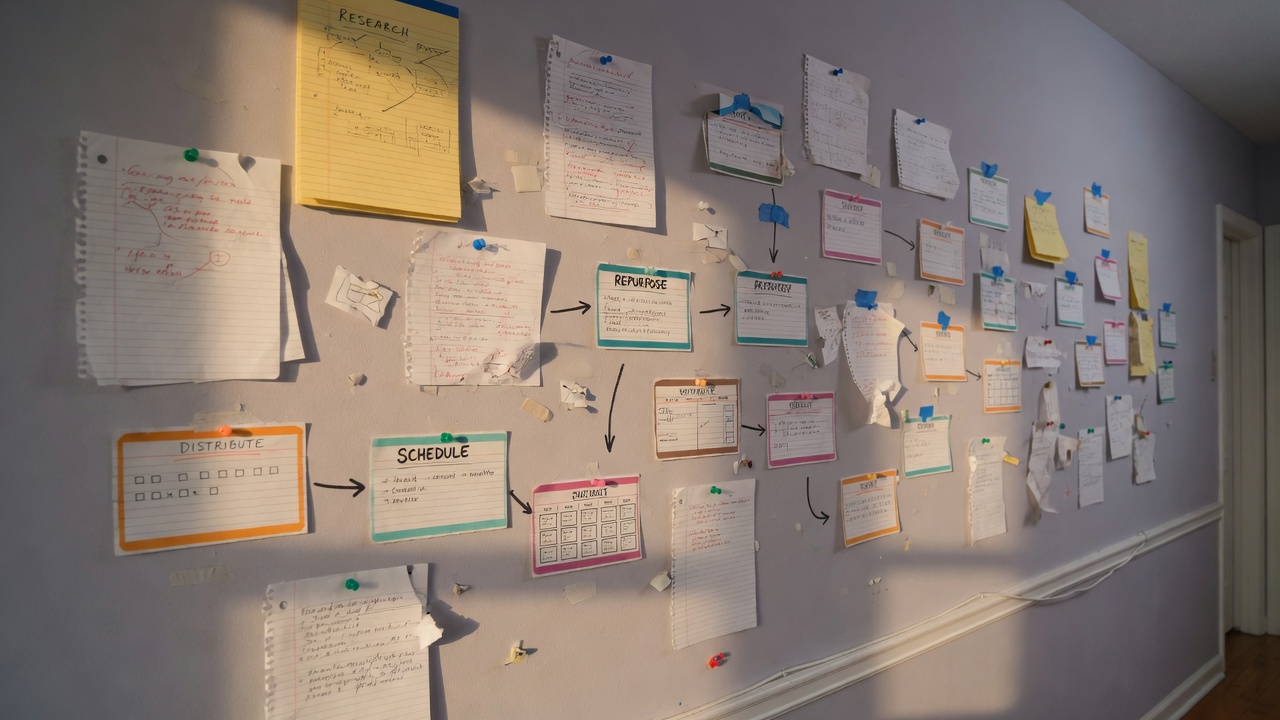
You can get a fast draft out of a chatbot. You can't get a system that remembers what you sound like on Tuesday and still sounds like you on Thursday, across five different channels, without you manually correcting it every time.
Adoption numbers back up how mainstream this workflow burden has become. Content creation sits at 41% adoption among the small businesses already using AI in some form, and marketing teams overall have normalized daily AI use for content work. The question for a solopreneur today isn't whether to use AI. It's whose system actually produces something reliable enough to stop checking twice.
Where the Real Leverage Point Sits
SMBs implementing AI agents with defined guardrails report efficiency gains and cost reductions within the first year, with measurable results often showing up inside the first month of use, according to SMB implementation research. That's a meaningful timeline for a solopreneur weighing whether an agent-based system is worth the setup effort. You're not waiting a quarter to know if it's working.
But the efficiency number, while useful, still isn't the headline. The headline is what that efficiency gets spent on. If an agent takes the repetitive 20-hour content grind and compresses it down, the real win isn't that you saved time.
It's that you can now spend that reclaimed time on the parts of your business an agent can't touch: client relationships, strategic decisions, the actual craft of running what you built. A content agent that frees up hours but produces content that doesn't sound like you has solved the wrong problem. A content agent that frees up hours and sounds unmistakably like you has solved both problems at once.
This is where scope matters. A solopreneur or a two-person marketing team running content across four or five channels is a strong fit for a governed, voice-trained agent system. A larger SMB with a dedicated marketing hire and an established content calendar might need a different configuration, with more manual review checkpoints built in given team capacity. There's no universal mandate here. The right setup depends on how many hands are already touching your content and how much drift you can tolerate before it costs you trust.
What This Means for the Solopreneur Reading This Today
If you've watched a few tutorials, tried a chatbot, gotten a serviceable draft, and then quietly gone back to writing everything yourself because nothing quite sounded like you, you're not behind. You're describing the exact experience the current wave of task-level AI tools produces for almost everyone who tries them. That's not a personal failure to figure out AI. It's a structural gap between doing isolated tasks with AI and running an actual system built around your voice.
The agent wave that's finally arriving for small business content isn't about replacing your judgment. It's about building a workforce you couldn't otherwise afford, one that's trained on how you actually sound and checked by you before anything goes out the door. That's a fundamentally different proposition than another chat window waiting for your next prompt.
Frequently Asked Questions
What's the difference between an AI tool and an AI agent for content?
A tool responds to a single prompt and stops. An agent operates within a defined workflow, handling multiple steps like research, drafting, and formatting for different channels, guided by rules and a trained voice profile rather than a one-off instruction.
Is fully autonomous AI content safe for a small business?
Most practitioner guidance recommends against it. Human review checkpoints before publishing catch tone problems and factual errors an agent might miss, and they keep your brand's judgment in the final decision rather than handing it entirely to software.
How fast can a solopreneur see results from an AI content agent?
Implementation research on SMB AI agents points to measurable efficiency gains within the first few weeks of adoption, not months, particularly when the agent is applied to one well-defined workflow like content production rather than an entire operation at once.
Why does brand voice consistency matter more than posting frequency?
Inconsistent voice across channels erodes trust quietly. A customer who encounters content that sounds like it came from different companies starts to question the brand behind it, even if each individual post looks fine on its own.
If you're running content solo and tired of drafts that need a full rewrite to sound like you, the next step isn't another prompt. It's training a system on your actual voice once, so every piece it produces starts sounding like you by default.
Sources
- Small Business AI Adoption: 52 Stats (2026) | theStacc (thestacc.com)
- AI Agents Statistics 2026: Market Data, Adoption and ROI (sqmagazine.co.uk)
- From Wait-and-See to All-In: How SMBs Are Rewriting Their AI ... (idc.com)
Researched from 13 vetted sources · average source authority DR 75