Presence Infrastructure: The Content Advantage Most Leaders Miss
Most enterprise content leaders are solving the wrong problem.
2026-06-02
Presence Infrastructure: The Content Advantage Most Leaders Miss
Most enterprise content leaders are solving the wrong problem. They're asking which AI tool produces the best output, which platform drives the most engagement, which format their audience prefers this quarter. These are real questions. But they're downstream of a more fundamental one that almost nobody is asking: do you have the infrastructure to show up consistently, in your own voice, at the volume the market now requires? That's the presence infrastructure question. And the organizations that answer it well are pulling ahead of those still optimizing individual pieces of content.
The Diagnosis Most Content Teams Get Wrong
Content inconsistency is almost universally misdiagnosed. Leaders treat it as a motivation problem, a strategy problem, or a talent problem. They hire a new content manager, rebuild the editorial calendar, or run a brand refresh. Six months later, the same gaps appear. The volume drops off. The voice drifts. The publishing cadence collapses under the weight of everything else the business demands.
The actual problem is architectural. Content inconsistency is a production architecture problem. The organization doesn't have a repeatable system for capturing, producing, and distributing content at scale. It has a collection of individual efforts that depend on specific people being available, motivated, and uninterrupted. When any of those conditions breaks, the content stops. And in most organizations, those conditions break constantly.
This distinction matters because it changes the solution entirely. You can't motivate your way out of a broken production system. You can't hire your way out of it either, not sustainably. The fix is structural, and it starts with understanding what presence infrastructure actually means.
What Presence Infrastructure Actually Means
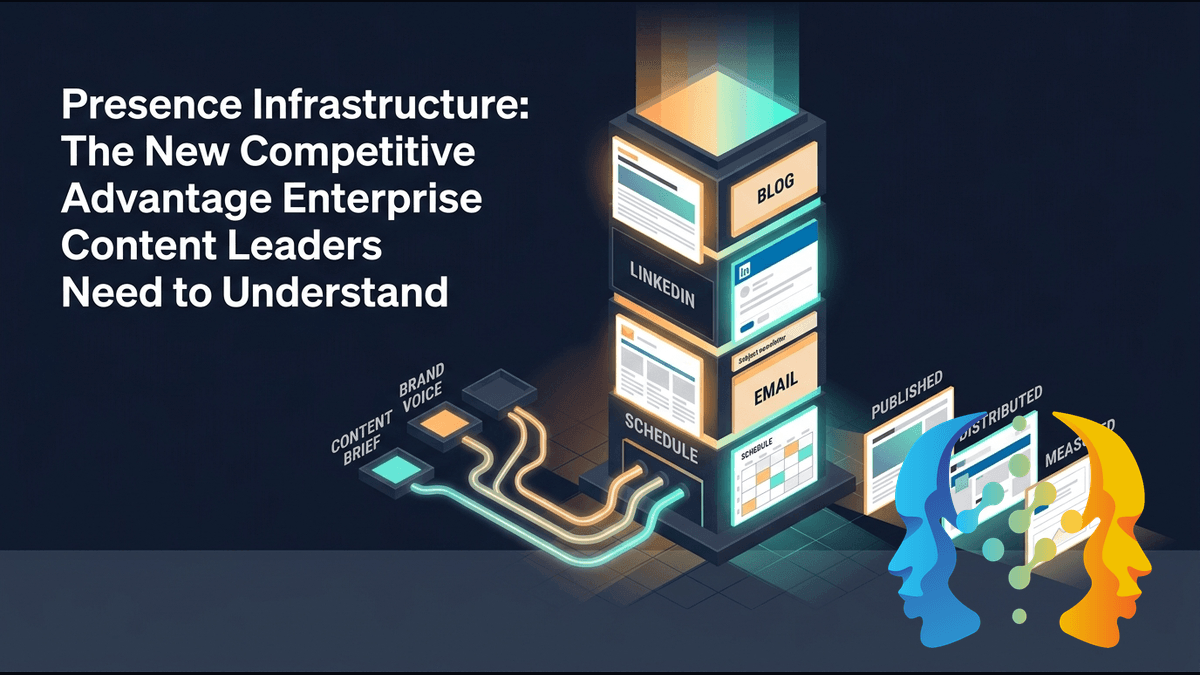
Presence infrastructure is the combination of systems, workflows, and assets that allow an organization to maintain a consistent, authentic content presence without depending on any single person's daily availability. Think of it the way you'd think about IT infrastructure or financial infrastructure. It's not glamorous. It doesn't generate headlines. But when it's working, everything else runs. When it's missing, everything else is fragile.
Film production figured this out decades ago. A major production doesn't depend on the director being available every hour of every day to make decisions. There's a system: pre-production locks in the creative vision, production captures the raw material, post-production shapes it into finished assets, and distribution gets it in front of audiences. Each phase has defined roles, defined outputs, and defined handoffs. The director's creative judgment is embedded in the system, not bottlenecked inside the director's calendar.
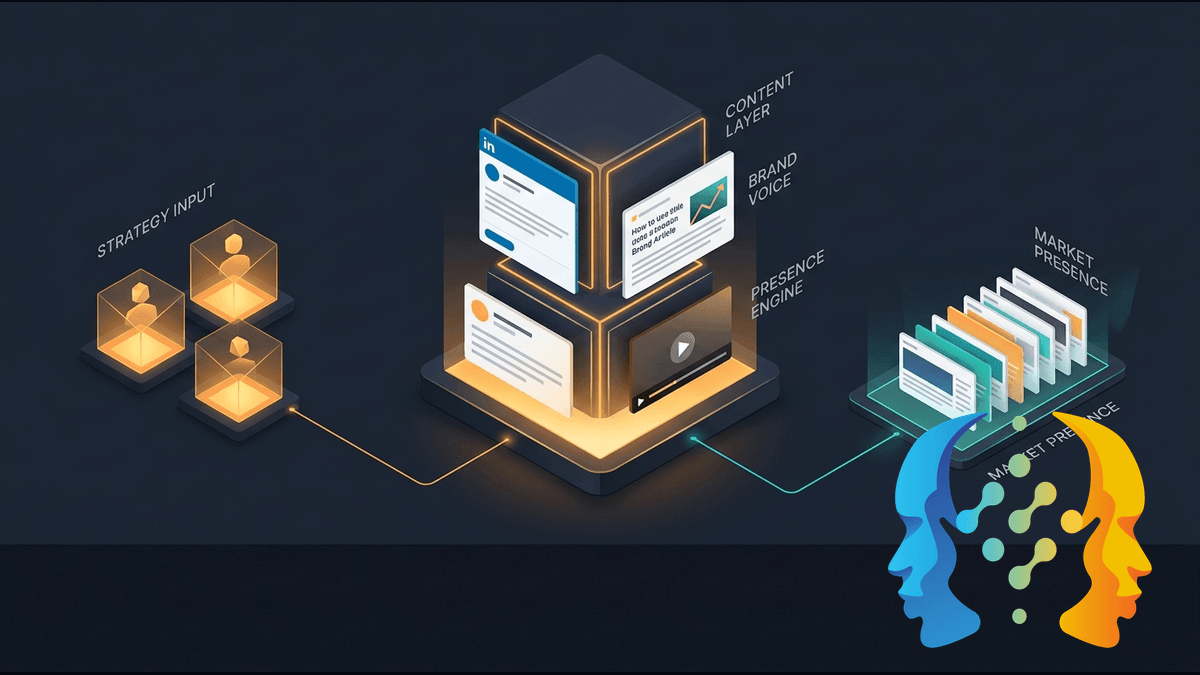
Content operations work the same way when they're built correctly. The founder's voice, the brand's perspective, the organization's point of view, these get captured, systematized, and distributed through a production workflow that doesn't require the founder to be present for every piece. That's presence infrastructure. And most enterprise content teams don't have it.
Why AI Tools Alone Won't Build It
Here's where a lot of organizations are making an expensive mistake right now. They're adopting AI content tools and expecting the tools to solve the consistency problem. They won't. AI tools are production accelerators. They're not production systems. There's a meaningful difference.
A production accelerator makes individual tasks faster: drafting, editing, reformatting, translating. That's genuinely useful. But if the underlying workflow is broken, if there's no clear editorial rhythm, no defined voice standards, no repurposing pipeline, no approval process, AI just accelerates the chaos. Organizations that already publish consistently get the biggest benefit from AI tools. Those struggling to be consistent rarely reach the threshold where the AI becomes genuinely useful, because the limiting factors aren't speed or cost. They're clarity of narrative, operational rhythm, and repeatable workflow.
The research on this is consistent: tool access does not equal content consistency. The organizations winning the content game right now aren't the ones with the best tools. They're the ones with the best operating models. Tools are abundant. Operating systems are rare.
The Four Components Enterprise Leaders Need to Audit
If you want to assess whether your organization has presence infrastructure or just a content wish list, look at four things:
- Voice documentation. Can any member of your team produce content that sounds like your brand without asking someone else for approval? If the answer is no, your brand voice lives in someone's head, not in your system.
- Production rhythm. Do you have scheduled, protected time for content production, or does content get created in the gaps between everything else? Gaps-between-everything-else is not a production system. It's a hope.
- Asset atomization. When you produce one piece of content, how many usable derivatives do you get from it? A single founder interview should yield a blog post, a LinkedIn article, several short-form video clips, pull quotes for social, and material for an email sequence. If you're getting one asset from one production session, you're leaving most of your investment on the table.
- Governance and approval workflow. Does your team know who approves what, in what timeframe, before content publishes? Unclear governance is one of the most common hidden causes of content delays and inconsistency, especially in organizations with multiple stakeholders or brand-sensitive verticals.
Most enterprise content teams can answer two of these four questions confidently. The other two are where the production architecture breaks down. That's where the audit gets honest.
The Founder Visibility Trap at Enterprise Scale
The founder visibility problem isn't unique to small businesses. It scales up. In enterprise contexts, it becomes the executive visibility problem, or the subject matter expert bottleneck. The organization has people with genuine expertise and authentic perspectives. Those people are also the busiest people in the building. So content either waits for them, or it gets produced without them and sounds generic.
Neither outcome is acceptable when your audience can tell the difference. And they can. The research on audience trust is clear: content that is technically competent but emotionally hollow is losing audience confidence. People don't just want information. They want to know there's a real perspective behind it. They want to feel the human judgment in the content, not just the facts.
The answer isn't to demand more time from your executives and experts. It's to build a system that captures their voice and perspective in concentrated sessions and distributes that material over time. One well-structured interview session with a subject matter expert can fuel weeks of authentic content. But only if you have the production infrastructure to capture, process, and distribute it systematically. Without that infrastructure, the interview sits in a folder somewhere and nothing ships.
Authenticity at Scale Is a Technical Problem, Not Just a Creative One
There's a tendency to treat brand authenticity as a purely creative challenge. Get the right writers, brief them well, and the voice will come through. That works at low volume. It breaks at scale.
When you're producing content across multiple channels, multiple formats, and multiple team members, voice consistency becomes a technical and operational challenge. You need systems that encode your brand voice in ways that any contributor, human or AI-assisted, can apply reliably. You need review processes that catch drift before it publishes. You need feedback loops that improve the system over time rather than just correcting individual mistakes.
The organizations getting this right are treating brand voice the way engineers treat code standards: documented, version-controlled, and enforced through process rather than individual judgment. That's not a creative constraint. It's what makes creative work scalable without losing what makes it yours. The goal is content that's Human-Prompted and Human-Approved™, where the system amplifies human judgment rather than replacing it.
What Building Presence Infrastructure Actually Looks Like
Building presence infrastructure is a 90-day project, not a weekend sprint. It requires honest assessment of where your production system actually breaks, not where you wish it didn't. But the sequence is straightforward.
Start with voice. Document your brand's perspective, vocabulary, and editorial standards in enough detail that someone new to your team could produce recognizable content from the documentation alone. This is harder than it sounds. Most organizations discover they've never actually articulated their voice, having relied instead on institutional knowledge that walks out the door when people leave.
Then build the production rhythm. Identify your highest-value content formats and schedule dedicated production time for them. Protect that time the way you'd protect a client commitment. Content production that competes with everything else always loses to everything else.
Then build the atomization pipeline. Define, in advance, how each primary content asset will be broken down into derivative assets. A 30-minute recorded conversation should have a defined output list before the recording starts. That's how film productions work. It's how high-output content teams work too.
Finally, document the governance workflow. Who approves what. What the turnaround expectation is. What happens when the primary approver is unavailable. These decisions feel administrative until the moment they're not made and content either stalls or ships wrong.
Frequently Asked Questions
What is presence infrastructure in content marketing?
Presence infrastructure refers to the systems, workflows, and assets that allow an organization to maintain a consistent, on-brand content presence without depending on any single person's daily availability. It includes voice documentation, production scheduling, asset atomization processes, and governance workflows.
Why do AI content tools fail to solve content inconsistency?
AI tools accelerate individual production tasks but don't replace the underlying operational system. Organizations without a clear editorial rhythm, defined brand voice, and repurposing workflow find that AI tools scale their existing chaos rather than fixing it. Consistency requires a production system, not just faster drafting.
How do enterprise content teams maintain brand voice at scale?
The most effective approach treats brand voice as a documented standard rather than institutional knowledge. This means written voice guidelines detailed enough for any contributor to apply, review processes that catch drift before publishing, and feedback loops that improve consistency over time across all channels and formats.
What's the difference between a content strategy and a content operating system?
A content strategy defines what you want to say and to whom. A content operating system defines how content gets produced, approved, and distributed reliably over time. Most organizations have some version of the former. Very few have the latter. The operating system is what makes the strategy actually happen at consistent volume and quality.
If your content team is producing good individual pieces but struggling to maintain volume, voice, and cadence across channels, the gap is almost certainly in your production architecture. The next step is an honest audit of the four components above. Start there, and the tool decisions become much clearer. Presence infrastructure is what makes every other content investment pay off.