Omnichannel Marketing Strategy for Small Teams: 3 Tests for Silos
Build an omnichannel marketing strategy for a small team with unified customer data, mapped journeys, incrementality tests, and consistent content.
By Steve Sanford · 2026-10-19

Omnichannel Marketing Strategy for Small Teams: 3 Tests for Silos
An omnichannel marketing strategy connects every customer touchpoint, web, app, store, and social, around one continuous experience rather than a set of disconnected channels. The payoff is concrete: a better customer experience and stronger intent to keep using your channels when consistency and seamlessness work together across touchpoints, according to research on consistency and seamlessness. None of it works without unified customer profiles behind the scenes.
TL;DR:
- Unify customer records and sync purchases before personalizing; stale or incomplete data can make tailored messages less trustworthy than generic ones.
- Check profiles across channels, service visibility into recent purchases, and whether email promotions stop after an off channel conversion; failures indicate disconnected operations.
- Start with one high priority journey, unify its data, coordinate message triggers, then test with a holdout group before expanding to other touchpoints.
- Use randomized holdouts or geographic tests for major budget decisions; reserve attribution and lighter models for routine optimization, since they do not prove causation.
- A strong omnichannel experience makes customers who seek novelty or value their time more likely to refer and give feedback, so prioritize those segments rather than imposing one journey on everyone.
Table of Contents
- What omnichannel marketing means and why it matters now
- Omnichannel vs multichannel: what to do differently
- The four pillars that make or break your strategy
- How to build an omnichannel marketing strategy step by step
- Proving omnichannel impact: attribution versus incrementality
- Omnichannel examples: where to focus your touchpoints
- How a done-for-you content service keeps your message consistent
- Where AI and automation actually move the needle
- Personalizing content at scale without losing the plot
- Why human oversight still matters in AI-driven content
- Keeping channels consistent when you’re a small team
- Get consistent omnichannel content without building a content team
- FAQ
- Sources
What omnichannel marketing means and why it matters now
Omnichannel marketing treats the customer, not the channel, as the organizing unit. Every touchpoint, email, app, in-store visit, pulls from the same customer profile and reflects the same context, so a shopper who adds an item to their cart on mobile can finish the purchase in a store without repeating themselves.
The business case is no longer theoretical. Businesses that get consistency and seamlessness right together see better customer experience scores and continuance intention. A related study on journey design found that cohesion and context sensitivity across touchpoints improve omnichannel experience, which in turn lifts value co-creation.
A few signals tell you it’s time to prioritize this work:
- Customers complain about repeating information across channels.
- Marketing, sales, and service teams each hold separate customer records.
- Campaign performance looks strong in one channel but customer retention stays flat overall.
Omnichannel vs multichannel: what to do differently
Multichannel marketing runs channels independently, each with its own goals, messaging, and data. Omnichannel marketing starts from the customer’s intent and makes every channel aware of what happened in the others, a distinction laid out clearly in Salesforce’s comparison of the two models.
The operational consequences show up fast. Multichannel setups tend to produce data silos, duplicate messaging, and personalization that only works within a single channel. Three quick tests reveal which model you’re actually running:
- Pull a customer’s profile from two different channels and see if the data matches.
- Check whether a customer service agent can see a recent cart abandonment or purchase.
- Review whether a promotion triggered in email actually suppresses once the customer converts elsewhere.
If any of those checks fail, you’re running multichannel with omnichannel branding.
The four pillars that make or break your strategy
Consistency, seamlessness, integration, and personalization are not separate initiatives. They reinforce each other, and research on omnichannel customer experience shows that raising consistency and seamlessness together improves the customer experience, per MDPI’s analysis.
- Consistency means the same offers, pricing, and tone appear everywhere. Quick win: audit your last three campaigns across channels for mismatched messaging.
- Seamlessness means a customer can move between channels without friction or repetition. Quick win: test your own cart-to-checkout flow on mobile, then desktop.
- Integration means systems talk to each other in near real time, often through a customer data platform or synced CRM. Quick win: confirm how long it takes a purchase to reflect in your email tool.
- Personalization means messaging reflects what you already know about a customer, not generic segments. Quick win: check if your welcome series differs for returning versus new visitors.
Pro Tip: Fix integration before personalization. Personalized messages built on stale or incomplete data erode trust faster than generic ones.
How to build an omnichannel marketing strategy step by step
Teams move faster from fragmented channels to a working omnichannel setup when they follow a defined sequence rather than tackling everything at once.
- Inventory every touchpoint your customers actually use and gather existing research on where friction occurs.
- Map the customer journey end to end, marking where handoffs between channels currently break down.
- Unify customer data into a single profile, typically through a customer data platform or tighter CRM integration, following the unified-data approach Salesforce recommends.
- Orchestrate messaging rules so triggers in one channel suppress or adjust activity in another.
- Run controlled tests before scaling. Use holdout groups to isolate what the omnichannel changes actually caused, not just what correlates with them.
Segmentation matters at every step. An empirical study of US omnichannel customers found that a strong omnichannel experience makes novelty-seeking and time-conscious customers more likely to refer, give feedback, and influence others, which means a single journey map rarely fits your whole customer base. Build for your highest-value segments first, then expand.
Proving omnichannel impact: attribution versus incrementality
Attribution tells you which touchpoints a customer passed through before converting. Incrementality tells you whether your omnichannel investment caused that conversion or whether it would have happened anyway. Both have a place, but they answer different questions.
For high-stakes budget decisions, IAB’s incrementality guidelines recommend methods with stronger causal foundations, such as randomized holdouts or geo-level tests, rather than relying on attribution alone. For faster, lower-stakes optimization, lighter proxies are usually sufficient.
Measurement rigor should match the decision: strong causal tests for high-stakes budget calls, lighter models for tactical tuning.
Metrics worth tracking on an ongoing basis:
- Customer experience indicators tied to consistency and seamlessness scores.
- Retention and repeat purchase rate by segment.
- Customer lifetime value lift after journey changes.
- Incremental return on investment by channel, not just last-touch credit.
Omnichannel examples: where to focus your touchpoints
A grocery brand’s omnichannel journey might look like this: a customer discovers a product through a social ad, researches it on the brand’s app, adds it to a cart, then picks it up in store the same afternoon, with the same loyalty points and pricing applying at every step. That continuity is the entire point.
Common touchpoints worth building out, roughly in order of customer impact:
- Website and app, where much of the research and a growing share of transactions happen.
- Email and SMS, for timely, personalized follow-up.
- In-store experience, including point-of-sale data capture.
- Social channels, for discovery and customer service.
- Retail media and digital shelf placements, which NIQ’s recent market data flags as core to omnichannel execution rather than a separate line item.
Prioritize touchpoints where customers already move between channels most often, not the ones that are easiest to instrument.
How a done-for-you content service keeps your message consistent
Keeping tone and messaging aligned across a blog, social posts, and ad copy takes real coordination, and many small teams don’t have the hours for it. We produce researched blog posts, social content, and content briefs that stay on-brand across every channel we touch, backed by Contero IQ™, our brand voice engine, and a mandatory human approval step before anything publishes.
- Content briefs and drafts are grounded in market research, not generic templates.
- The brand voice technology profiles each client’s voice so posts sound like the same brand everywhere.
- Human approval catches tone drift before it reaches a customer.
For small teams, that combination means faster output without losing the consistency an omnichannel strategy depends on.
Where AI and automation actually move the needle
AI earns its place in omnichannel marketing by handling the coordination work that used to require a much larger team: syncing customer data in near real time, triggering the right message on the right channel, and flagging when a customer’s behavior contradicts your current campaign logic. None of that replaces strategy, it executes it faster and more consistently than manual rules ever could.
The clearest wins show up in three areas. First, real-time personalization: automation can adjust product recommendations or offers the moment a customer’s behavior changes, rather than waiting for a weekly segment refresh. Second, channel orchestration: automated rules can suppress a promotional email the instant a customer completes that purchase elsewhere, closing the gap that multichannel setups usually leave open. Third, pattern detection: automation surfaces friction points in a journey, like a spike in cart abandonment right after a shipping cost reveal, faster than manual reporting typically catches them.
The risk is treating automation as a substitute for judgment. Automated systems optimize for the patterns they’re given, and when those patterns are based on incomplete data or stale segments, they scale the mistake just as efficiently as the win. Segmentation research backs this up: effects vary by customer trait and relationship stage, so a model trained on your average customer can underperform for your novelty-seeking or time-conscious segments. Automation works best as an execution layer sitting on top of strategy decisions a person still makes.
Personalizing content at scale without losing the plot
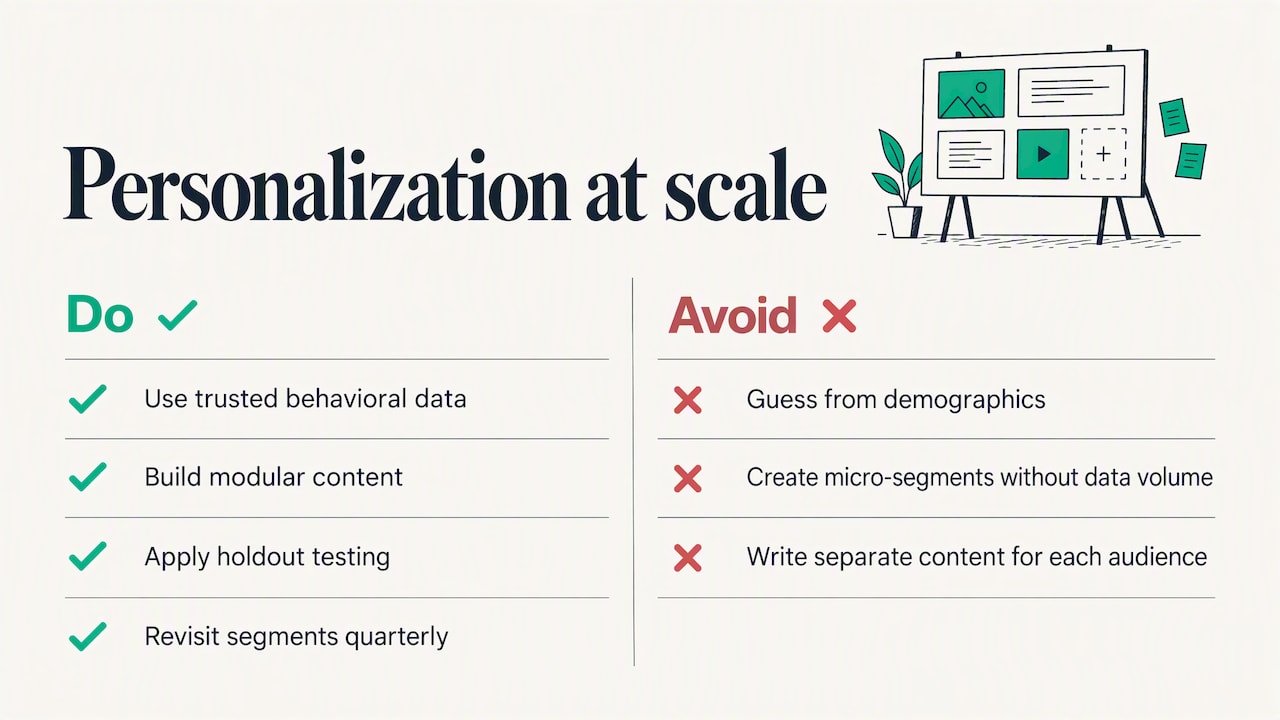
Personalization at scale fails most often not from lack of technology but from lack of a clear hierarchy: teams try to personalize everything at once instead of starting with the signals that actually predict behavior.
Start with behavioral data you already trust: purchase history, browsing patterns, and lifecycle stage, rather than demographic guesses. A returning customer and a first-time visitor should never see the same welcome message, but beyond that basic split, resist the urge to create dozens of micro-segments before you have the data volume to support them.
Build modular content rather than one-off pieces for each segment. A single blog post or email template with swappable sections, a product recommendation block, a localized offer, a dynamic subject line, scales far better than writing entirely separate content for each audience. This is also where a documented brand voice matters: personalization without a consistent voice underneath it just produces inconsistent-sounding messages at higher volume.
Test personalization the same way you’d test any other channel change. A segment that converts better on a personalized email doesn’t automatically mean the personalization caused it, so apply the same holdout thinking from your incrementality testing here. And revisit segments quarterly. Customer relationship stage shifts over time, and a tactic that worked for a new customer often needs adjusting once that customer becomes a repeat buyer, consistent with findings on relationship-stage effects in omnichannel engagement.
Why human oversight still matters in AI-driven content
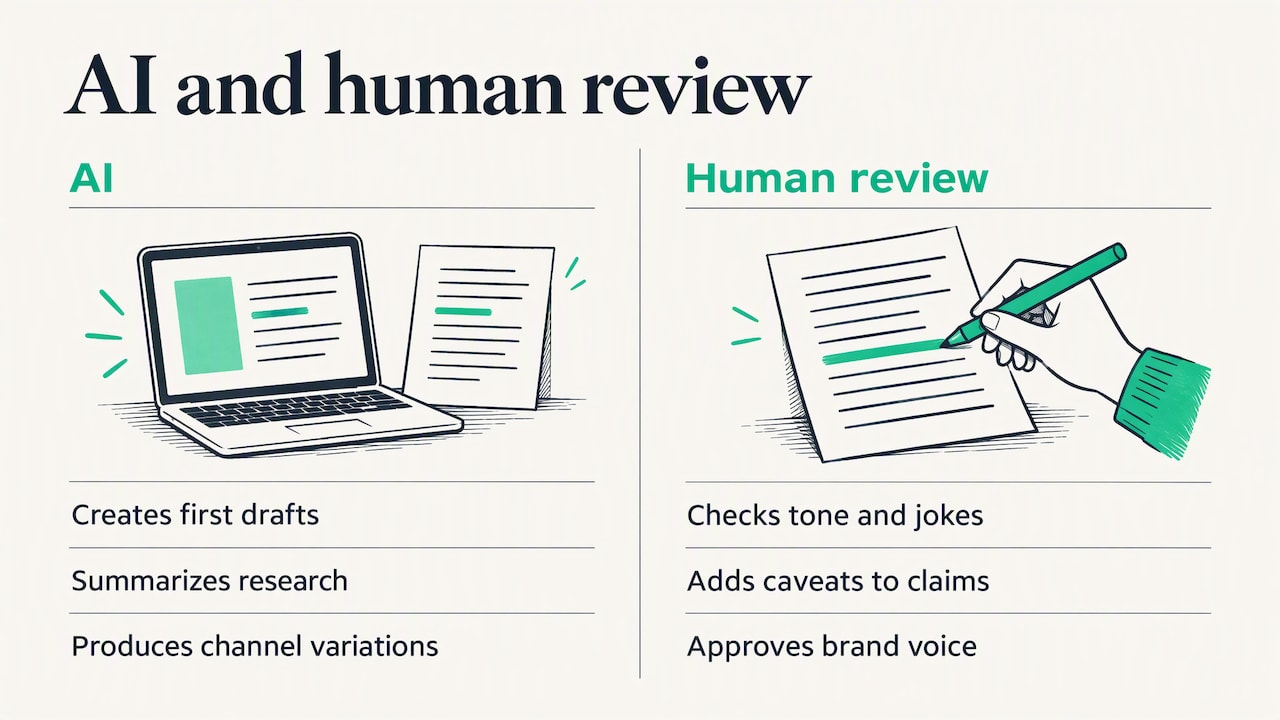
AI can draft content fast, but speed without a check creates its own risk: generic phrasing, factual drift, or a tone that quietly stops sounding like your brand after enough iterations. The fix isn’t choosing between AI and human review, it’s building a workflow where each does the part it’s actually good at.
AI handles the volume work well: first drafts, research summaries, variations for different channels. Human reviewers catch what AI consistently misses: whether a joke lands, whether a claim needs a caveat, whether the piece still sounds like the brand a customer already knows. That division of labor is why we route every piece of content we produce through a human approval step before it ever reaches a client’s channel, regardless of how the first draft was generated.
The practical test for any team building this workflow is simple: could a customer tell the difference between content a person wrote from scratch and content a person edited after an AI draft? If the answer is no, the oversight step is working. If messaging starts to feel flat or interchangeable across clients or campaigns, that’s a sign the human step got skipped or rushed, not a sign to add more automation.
Keeping channels consistent when you’re a small team
Small and mid-size businesses face a specific version of the consistency problem: not enough hands to review every channel, every week, against a single brand standard. The result is usually not bad content, it’s drifting content, where tone and messaging slowly diverge across email, social, and the website without anyone deciding that should happen.
The most common cause is a missing source of truth. When brand voice lives in one person’s head rather than a documented profile, consistency depends entirely on that person reviewing everything, which doesn’t scale past a handful of channels. The fix is less about hiring and more about documentation: a written voice guide, even a simple one, gives anyone creating content a reference point that doesn’t depend on memory.
The second common cause is tool sprawl. A different platform for email, social, and blog content often means three different approval processes and three different versions of “on brand.” Consolidating content creation through a single workflow, even if it’s not fully automated, reduces the number of places drift can creep in.
The third is simply time. Reviewing every piece of content against a brand standard takes real hours, and small teams often skip that step under deadline pressure. This is precisely the gap a managed content service closes: brand voice technology paired with mandatory human review means the consistency check happens by default, not only when someone remembers to do it.
Get consistent omnichannel content without building a content team
Coordinating consistent messaging across a blog, social, and ad channels takes ongoing attention most small teams can’t spare. We handle that work end to end: researched blog posts, social content, and campaign copy built around your brand voice through Contero IQ™, with every piece reviewed by a person before it goes out.
If you’re ready to see how this fits your channels, check our plans and pricing or visit Contero to get started.
FAQ
What is an omnichannel strategy in marketing?
An omnichannel strategy coordinates every customer touchpoint, website, app, email, social, and in-store, around a single customer profile so the experience feels continuous rather than fragmented. It differs from multichannel marketing, which runs each channel independently, as explained in Salesforce’s omnichannel primer.
What are the 4 C’s of omnichannel?
Definitions vary across sources, but a common version centers on consistency, continuity, context, and convenience across channels. The throughline in each version is the same: customers should experience one coherent brand, not a set of disconnected channels.
What are the four pillars of omnichannel marketing?
Four pillars often cited are consistency, seamlessness, integration, and personalization. Research on customer experience shows raising consistency and seamlessness together improves the experience, while integration and unified data make the other two possible.
How do I measure whether my omnichannel strategy is working?
Track both attribution, which touchpoints customers pass through, and incrementality, whether your changes actually caused the outcome. IAB’s measurement guidelines recommend holdout tests or geo experiments for high-stakes decisions and lighter models for ongoing optimization.
Can a small business realistically run an omnichannel strategy?
Yes, though small teams usually need to prioritize one or two journeys rather than every channel at once. Documenting a brand voice and consolidating content creation, whether in house or through a managed service, closes most of the consistency gap that otherwise limits smaller teams.
Sources
- Demystifying the combined effect of consistency and seamlessness on omnichannel customer experience (MDPI, 2024)
- Guidelines for incremental measurement in commerce media (IAB, Nov 2025)
- Omnichannel vs multichannel (Salesforce)
- Empirical analysis of US omnichannel customers (RePEc / JBR, 2025)