Instagram Content Ideas for Small Businesses That Work
Instagram content ideas for small businesses: five pillars, formats matched to goals, a weekly plan and a repeatable system so you never stare at a blank calendar.
By Steve Sanford · 2026-10-27

Instagram Content Ideas for Small Businesses That Work
The best Instagram content ideas for a small business are not random prompts. They come from a few repeatable pillars (proof, people, education, offers and community), each matched to a format and a single goal. Below you will find specific ideas for each pillar, a simple weekly plan, and a way to turn one idea into several posts so you are not starting from zero every Monday.
Table of Contents
- Why a list of ideas is not a content plan
- The five pillars of a small business content bank
- Proof: show the work is good
- People: put a face on the business
- Education: answer what customers keep asking
- Offers: sell without sounding like a flyer
- Community: give followers a reason to reply
- Choosing the right format for the goal
- A simple weekly rhythm (and what the 5-3-1 rule really is)
- Build a content plan in five steps
- Turn one idea into five posts
- When ideas are not the real problem
- Where Contero fits
- Common mistakes to avoid
- FAQ
- Sources
Why a list of ideas is not a content plan
Most small business owners do not lack ideas. They lack a system. A list of 30 prompts feels useful on Tuesday and is forgotten by Friday, because nothing ties each idea to a business outcome.
The practical mistake is treating ideas as a calendar. Buffer’s guidance points the other way: start with the job the post has to do. Reels are generally suited to discovery, carousels and feed posts to explanation and engagement, and Stories to timely interaction and replies. So give every idea four attributes before it goes on a calendar:
- A goal: reach, trust, conversation or a sale.
- A format: Reel, carousel, single image, Story or Live.
- A proof point: the customer result, number, photo or process that makes it believable.
- One next step: save, reply, click the link in bio, book a call.
This is also the difference between building volume and building a brand. We have written about why posting more often can make your brand invisible: noise is easy to produce, recognition is not.
The five pillars of a small business content bank
Small business ideas recur across the major guides. HubSpot lists 18, Buffer 29, Sprout Social 20 and Shopify 13. Collapse them and you get five pillars:
| Pillar | What it does | Typical formats |
|---|---|---|
| Proof | Shows results and builds trust | Carousels, single images, short Reels |
| People | Makes the business human | Stories, Reels |
| Education | Demonstrates expertise, earns saves | Carousels, Reels |
| Offers | Tells people what you sell and how to buy | Reels, carousels, feed posts |
| Community | Starts conversations | Stories, Lives, polls |
The rest of this guide fills each pillar with ideas you can use this week.
Proof: show the work is good
Proof is the pillar most small businesses underuse, and the one that moves buyers. Shopify cites an Edelman study finding that 84% of surveyed people said they need to share values with a brand in order to buy from it, and a Salsify study finding that 40% of shoppers considered user-generated content very or extremely important in a purchase decision. Those are survey findings, not conversion rates, but they support the same conclusion: specific customer experiences beat polished product shots on their own.
Ideas to use:
- Before and after. A cleaned kitchen, a redesigned logo, a tidied bookkeeping file. Show the starting point honestly.
- Customer result carousel. Slide one is the problem, the middle slides are what you did, the last slide is the outcome and a single call to action.
- Review screenshots with context. Pair a short review with a photo of the job it refers to.
- Permissioned customer content. Reshare photos or videos customers tag you in, after asking.
- Numbers you can stand behind. A count of projects completed this quarter, average turnaround time, years serving a particular neighborhood.
Only post what you can verify. A vague “clients love us” post proves nothing; a named result, with the customer’s permission, does.
People: put a face on the business
If your competitors sell the same thing, the people behind it are the part that cannot be copied. Social media consultant Rachel Karten, quoted by Shopify, advises businesses to find what only they could show. Generic motivational quotes are easy to copy. Decisions, processes and tradeoffs are not.
Ideas to use:
- Day in the life. Instagram head Adam Mosseri, as quoted by Shopify, recommends behind-the-scenes and day-in-the-life content in Stories. That fits: Stories carry the informal layer and disappear after 24 hours unless you save them to Highlights.
- Meet the team. One person, one fun fact, one thing they are proud of this month.
- Founder story. Why you started, what almost went wrong, what you would do differently.
- How it is made. The workspace, the tools, the prep before the customer arrives.
- Hiring and milestones. A new hire, an anniversary, a first big client. These tell followers you are growing and stable.
Education: answer what customers keep asking
Educational posts are the ones people save, and saves tell Instagram and your future customers that the content is worth keeping. HubSpot’s planning advice is to begin with what your ideal customer cares about, not simply with what you sell.
A fast way to find topics: list the last ten questions customers asked by phone, email or in the DMs. Each one is a post.
Ideas to use:
- FAQ carousel. Five questions, five slides, one clear answer each.
- Myth versus fact. Pick the misconception that costs you the most sales conversations.
- Quick tutorial. A 30-second Reel showing one task, start to finish.
- Comparison. Two approaches side by side, with an honest note on when each makes sense.
- Data-backed insight. One number from your own work or a credible public source, explained in plain language.
- Expert Q&A. Answer a question submitted through a Stories question sticker.
Service businesses can borrow from product-focused lists too. Sprout Social’s examples adapt easily: before-and-after transformations, how-to tutorials, a team member takeover and an infographic built from case study data.
Offers: sell without sounding like a flyer
People follow business accounts partly because they might buy. Hiding the offer helps no one. The trick is to make each offer post answer a question the buyer already has.
Ideas to use:
- Use case post. “Here is how a [type of customer] uses this service.” Concrete beats general.
- Process explainer. What happens between the first call and delivery, in four steps.
- Launch or seasonal promotion. New service, limited slots, holiday hours.
- Pricing clarity. If you can publish prices or ranges, do. Uncertainty about cost is a common reason people never message.
- Lead magnet. A checklist or template offered in exchange for a DM or email.
Every offer post needs one next step. Do not ask people to like, comment, share and click all at once.
Community: give followers a reason to reply
Conversation is the pillar that keeps an account from feeling like a billboard. Buffer groups polls and question stickers as interactive content, Shopify lists Q&As and interviews as interactive post ideas, and these are the formats that generate replies.
Ideas to use:
- Poll Stories. “Which of these two options should we offer next month?” Then act on the result and say so.
- Local spotlight. Feature a neighboring business, a local event or a customer who is also a business owner. This works especially well for firms serving a specific region.
- Interview. A five-minute chat with a supplier, partner or customer.
- Timely posts. Holidays, local events, industry dates, seasonal needs. Keep them relevant to your customers, not just the calendar.
- Ask me anything. Invite questions in Stories and answer them in the feed if they come up repeatedly.
Choosing the right format for the goal
The best Instagram content depends on what you want from it. Based on Buffer’s format overview and Shopify’s groupings, here is a practical guide:
| If you want | Use | Example |
|---|---|---|
| Reach new people | Short Reels, trend-aware formats | A 20-second “mistake to avoid” video |
| Saves and expertise | Carousels, how-to posts, before-and-afters | FAQ carousel, transformation post |
| Conversation | Stories, polls, Q&As, interviews | Poll sticker, question box |
| Purchase decisions | Testimonials, use cases, clear offers | Customer result carousel |
Static posts and carousels stay on your profile, so they suit evergreen FAQs and portfolios. Stories disappear after 24 hours unless saved, and Reels are useful for expanding reach, as Constant Contact notes.
A simple weekly rhythm (and what the 5-3-1 rule really is)
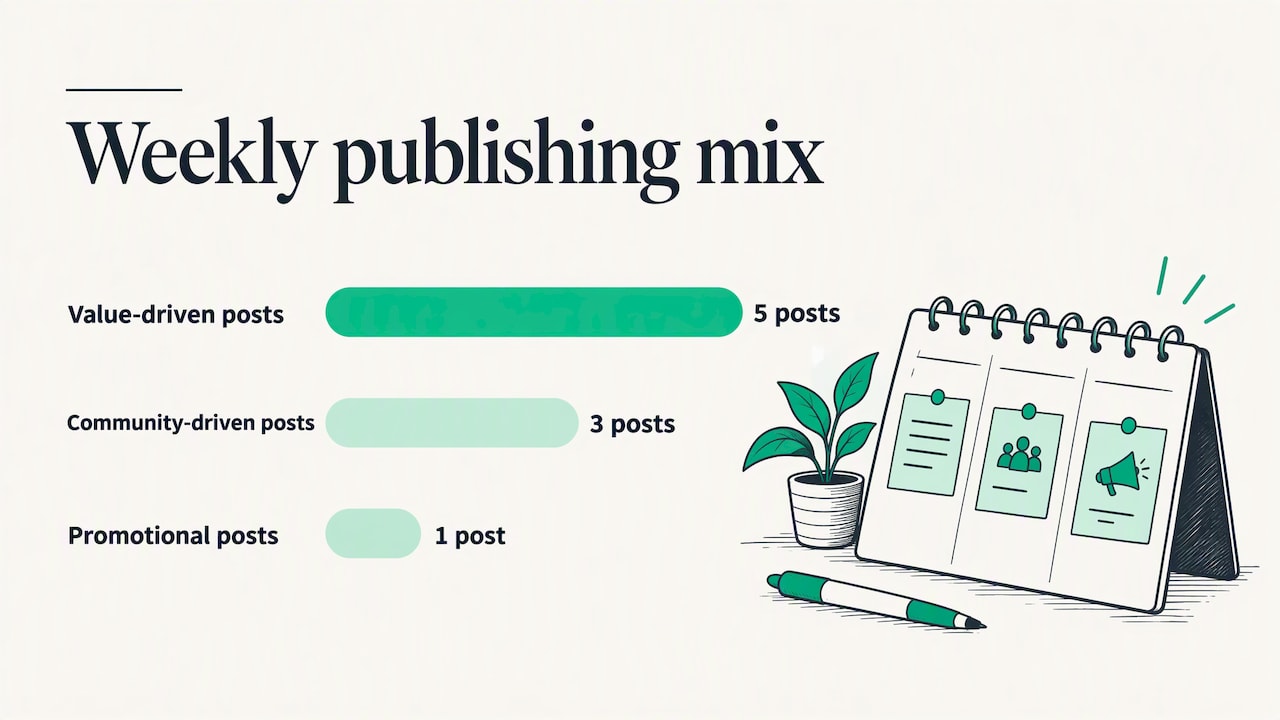
A common question is about the 5-3-1 rule. It is a publishing mix, not an Instagram requirement: five value-driven posts, three community-driven posts and one promotional post. Use it as a flexible heuristic. Your real ratio should follow audience response, sales priorities and how much you can realistically produce.
On volume, the guidance is modest. Constant Contact says many small businesses find a groove with two or three feed posts or Reels a week plus a couple of Stories for timely updates. That is guidance, not a benchmark, but it is a good reminder that a schedule you keep beats an ambitious one you abandon.
Here is a sample week for a small service business:
- Monday, education carousel: answer one recurring customer question.
- Wednesday, people Reel: a short behind-the-scenes clip from a real job.
- Friday, proof post: a customer result or permissioned UGC, with one call to action.
- Two Stories during the week: a poll and a quick look at your day.
- Every second week, one offer post: a use case or a seasonal promotion.
That is about three feed posts, two Stories and a periodic offer. Swap pillars based on what your Insights show.
Build a content plan in five steps
Searchers often ask for an Instagram content plan rather than a list of ideas. Here is the shortest version that works.
- Define the goal for the quarter. Leads, bookings, local awareness or retention. Pick one.
- Choose two or three formats. Constant Contact’s advice to lead with content pillars and consistency applies: fewer formats, done steadily.
- Batch ideas by pillar. Write ten ideas per pillar in one sitting. You now have 50 ideas, each with a goal.
- Test for a month, then compare. HubSpot recommends testing an approach consistently for a month and comparing formats, such as video against text-led images, rather than assuming one works for everyone.
- Review Insights weekly. Look at saves, replies and profile visits, not just likes. Keep what works, retire what does not.
Turn one idea into five posts
Efficiency comes from reuse. Buffer’s format overview supports a portfolio approach, where feed photos, carousels, Reels, Stories and Lives serve different jobs and one source idea feeds all of them.
Say you publish a blog post answering “How do I know which service package fits my business?” You can:
- Make a carousel of the five decision criteria.
- Film a 30-second Reel of the single most common mistake.
- Post a Stories poll asking which criterion matters most.
- Reshare a customer example as a proof post.
- Answer follow-up questions in a Q&A Story.
One piece of research, five pieces of content, one consistent message. If you also work on LinkedIn, the same logic applies there, and our LinkedIn content strategy templates show how to structure it for small teams.
When ideas are not the real problem
If you have ideas but still are not posting, the cause is usually capacity or confidence. Writing, designing, scheduling and reviewing every post takes hours most owners do not have, and the gap shows up as irregular, generic content. We cover that pattern in content anxiety and why small businesses stop posting.
The fix is to protect the part only you can do (the real stories, the customer knowledge, the decisions) and hand off the production. That is a workable division of labor whether you hire a part-time coordinator, a freelancer or a managed service.
Where Contero fits
Contero is a done-for-you marketing service: AI-assisted, human-approved blog posts and custom social media content, with research, copywriting, design, publishing and reporting handled for you. Our Contero IQ™ engine analyzes your brand voice so content sounds like you, and every piece goes through human approval before it is published. You can read more about how Contero IQ™ works or how the process runs.
Published self-serve plans are STARTER at $79 per month and PRO at $299 per month, billed monthly. See the pricing for what each includes, or look at our Done-For-You Content service if you want the managed route. If you run an agency, see how we keep one voice per client.
Common mistakes to avoid
- Posting without a goal. If you cannot say what a post is for, skip it.
- Copying trends that do not fit. Trend-aware Reels help reach, but only if they connect back to what you sell.
- Using UGC without permission. Always ask before you reshare a customer’s photo or video.
- Promoting every day. A feed that is all offers trains people to scroll past.
- Ignoring Insights. Weekly review takes ten minutes and tells you which pillar to double down on.
- Sounding like everyone else. If your caption could appear on any competitor’s account, rewrite it with a specific detail only you know.
FAQ
What type of content is best for Instagram?
It depends on the goal. Short Reels suit reach, carousels and how-to posts suit saves and expertise, Stories and polls suit conversation, and testimonials and clear offers suit purchase decisions. Most small businesses do best mixing two or three of these steadily.
What is the 5-3-1 rule on Instagram?
It is a planning heuristic, not an Instagram requirement: five value-driven posts, three community-driven posts and one promotional post. Adjust the ratio to your audience’s response, your sales priorities and the time you actually have.
What should a small business post on Instagram?
Post across five pillars: proof (results, reviews, permissioned UGC), people (team, founder, behind the scenes), education (FAQs, tutorials, myths), offers (services, launches, use cases) and community (polls, interviews, local events). Each post should have one goal and one next step.
How often should a business post on Instagram?
There is no universal number. Constant Contact notes that many small businesses settle into two or three feed posts or Reels a week plus a couple of Stories. Choose a pace you can keep, then use weekly Insights to adjust.
Sources
- What to Post on Instagram: 18 Photo & Video Ideas (HubSpot)
- How to Plan Your Instagram Posts (HubSpot)
- Instagram post ideas (Buffer)
- Instagram for Business (Buffer)
- Instagram post ideas for new content (Shopify)
- 20 Instagram post ideas (Sprout Social)
- How to Use Instagram to Promote Your Business (Constant Contact)