AI Content Personalization: A Practical Guide for Small Businesses
AI content personalization explained for small businesses: what it is, where it pays off, where it backfires, and how to keep humans in charge of your brand voice.
By Steve Sanford · 2026-10-28

AI Content Personalization: A Practical Guide for Small Businesses
AI content personalization means using machine learning to tailor your messages, whether blog posts, emails, social posts or ads, to the audience and the brand voice they come from. For a small business, the useful version is rarely one-to-one targeting at massive scale. It is content that sounds like you, speaks to a defined customer segment, and is checked by a person before it goes live. This guide covers how it works, where it pays off, where it backfires, and how to set it up without a data science team.
Table of Contents
- What AI content personalization actually is
- Why it matters now
- The four Ds: a framework that scales down
- Start with the foundation, not the tool
- Brand voice is the personalization most small firms skip
- Where personalized AI content backfires
- Governance: the human layer, documented
- A worked example: one offer, three segments
- Measure net results, not output
- What to look for in a personalization partner
- How Contero handles it
- FAQ
- Sources
What AI content personalization actually is
The top-ranking explanations agree on the basics. IBM describes content personalization as using AI to deliver tailored emails, articles, product descriptions, videos or text messages based on what is known about a user. Generative models add a second capability: they can write the tailored version, not just choose which existing asset to show.
That gives you two distinct layers, and mixing them up is where many small businesses go wrong.
| Layer | What it does | Typical example | Data needed |
|---|---|---|---|
| Delivery personalization | Chooses which message a person sees | Product recommendations, send-time optimization | Behavioral and purchase history |
| Creation personalization | Writes content adapted to a voice, segment or channel | A blog post in your firm’s tone, three versions of one offer for three audiences | Brand voice samples, audience research |
Enterprise teams invest heavily in the first layer. Small and mid-sized businesses usually get more from the second, because it does not require a large customer database. It requires a clear picture of who you serve and how you talk to them.
Why it matters now
Two pressures push in opposite directions.
First, audiences have been trained to expect relevance. In a 2021 McKinsey survey, 71% of consumers expect companies to deliver personalized interactions, and 76% get frustrated when that does not happen. Those numbers come from surveys of general consumers, so treat them as a directional signal for B2C, not a promise for your niche. Even so, expect a similar pattern in B2B: buyers who see generic copy tend to skim it and move on.
Second, generic AI output is now everywhere. When every competitor can produce 20 posts a week, volume stops being an advantage. The difference is between building volume and building a brand. We wrote about the symptom in why AI content sounds like everyone else’s, and the fix is personalization at the voice level.
There is some evidence that the effort pays. McKinsey reports that personalization can lift revenues by 5 to 15% and increase marketing ROI by 10 to 30%. Those are broad estimates from consulting research, so read them as encouraging rather than a guarantee for your business.
The four Ds: a framework that scales down
McKinsey’s explainer on personalization names four building blocks of personalization at scale: Decisioning, Data, Design and Distribution. The framework was written with large organizations in mind, but each D has a small-business translation.
- Data. You do not need a data lake. You need your customer list segmented in a way that reflects real differences in need, your best-performing past content, and the questions your sales calls keep surfacing.
- Decisioning. In a large company, models score each customer’s propensity to act. In a small firm, decisioning is a person choosing which segment gets which message this month, informed by results.
- Design. McKinsey describes this as breaking content into small pieces that can be mixed and matched. For you, it is a documented brand voice, a set of core messages, and templates for each channel.
- Distribution. Integrating channels so communications stay coordinated. At small scale, that means a single calendar so your blog, social and ads do not contradict each other.
Notice that the heavy technical piece, decisioning, is the smallest part of the small-business version. The design and distribution work is where the effort goes.
Start with the foundation, not the tool
BCG’s work on restaurants, published in 2024, argues that success depends less on the AI tool than on a unified base of customer data, which it calls customer DNA. Without it, the AI lacks the context to infer customer preferences, so it cannot personalize well.
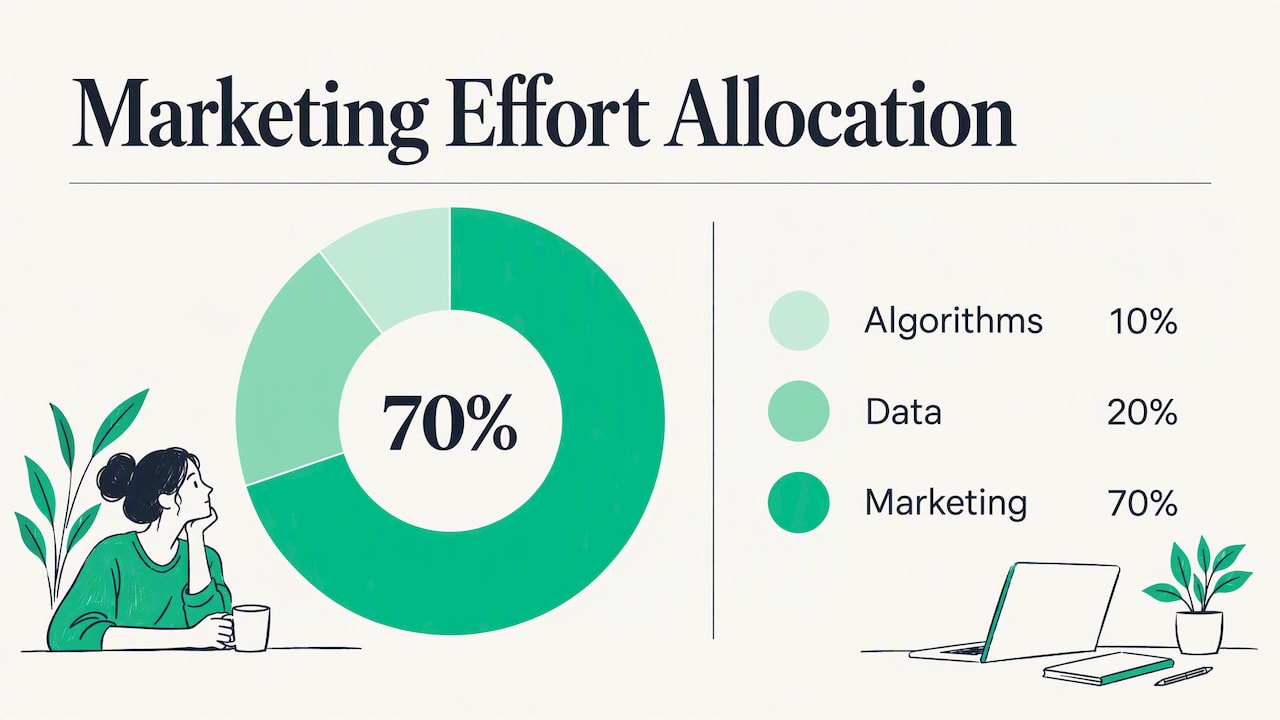
The same article offers a useful rule of thumb, often called the 10/20/70 rule: about 10% of the effort on algorithms, 20% on data and technical enablement, and 70% on rethinking how marketing is actually executed, including the operating model and approval processes. If you have seen people ask about the “10 20 70 rule for AI,” this is it. The takeaway for a small firm is blunt: buying a tool is the easy 10%. The 70% is who reviews, who approves, how often you publish, and what you do with the results.
A practical foundation checklist:
- Collect 10 to 20 pieces of writing that sound most like your firm: proposals, newsletters, your best posts.
- Write down who you serve in two or three segments, and the top three problems each one brings to you.
- List claims you can and cannot make, including anything regulated in your industry.
- Decide who approves content, and how fast they need to respond.
- Pick two or three numbers to track: inquiries, qualified leads, booked calls.
Brand voice is the personalization most small firms skip
Most advice on AI personalization talks about the customer. The first personalization is of the sender. If a prospect reads three pieces from you and they sound like three different companies, or like no company at all, no amount of segment targeting rescues the impression.
This is the core of what Contero IQ™ does for us: it profiles how a client writes and speaks, then uses that profile so drafts start from the client’s voice instead of a blank slate. You can read how that works on our Contero IQ™ page and in our overview of brand voice AI for small and mid-sized businesses.
Agencies face a sharper version of this problem, since each client needs a separate voice. We covered that in AI content for agencies: one voice per client.
Where personalized AI content backfires
Authorship and authenticity
Seven preregistered experiments in the AI-authorship effect study found that when consumers believe emotional marketing communications were written by AI rather than a human, positive word of mouth and loyalty decline. The same research found the effect weakens when the message is factual rather than emotional, or when AI only edits a message rather than writing it.
The practical lesson: use AI for drafting, research and consistency, but keep a named human responsible for what is published, and have a person write anything emotional, such as a founder story, an apology, or a thank-you, with AI only editing.
Privacy and the surveillance feeling
Researchers writing in the Journal of Advertising note a tension between personalization and consumer empowerment. Their advice is to be transparent about what data drives targeting and to give people simple controls, such as easy opt-outs, because aggressive retargeting can read as surveillance. IBM makes a similar point: good programs give people useful information without mining data they would be uncomfortable sharing.
For a small business, the safe default is to personalize from information customers knowingly gave you, such as their industry, their stated goals or their purchase history with you, and to avoid implying you know things you were never told.
Fabricated proof
Personalization sometimes tempts teams to generate testimonials or reviews tailored to a segment. Do not. The FTC announced a final rule in August 2024 that prohibits fake and AI-generated consumer reviews and testimonials that misrepresent who wrote them or whether the experience happened. It took effect on October 21, 2024. If you are unsure whether a practice qualifies, ask a lawyer familiar with advertising law.
Skipping the human review
The most common pitfall we see is publishing straight from the model. The Wine Access study from the University of Chicago Booth School, on large language models and email creative, found that a human-edited AI version earned the most net profit in two of its three trials, and frames the question as one of decision theory: does the AI-human workflow raise net profit after labor and software costs? A model that has never met your customers does not know your history, your relationships or your regulatory limits. A reviewer does.
Governance: the human layer, documented
The NIST AI Risk Management Framework is aimed at organizations that build and deploy AI systems, and it is voluntary. Still, its principle translates well to marketing: define human and AI roles clearly, and apply human judgment explicitly to risk. NIST’s Govern function stresses that policies and procedures underpin accountability.
A lightweight content governance policy for a small firm fits on one page:
- Roles. Who drafts (AI), who edits (a person), who approves (a named owner).
- Red lines. Topics, claims and data that never go into a prompt or a post.
- Disclosure. How you describe your use of AI to clients and audiences.
- Review cadence. A monthly look at what performed, what was edited heavily and why.
We laid out a longer version in content governance in 60 days, and our own approach is described on the AI ethical standards page.
A worked example: one offer, three segments
Imagine a three-person accounting firm that serves restaurants, contractors and dental practices. It wants to promote year-end tax planning.
A generic post says tax planning matters and invites readers to call. A personalized program does this instead:
- Research. Identify what each segment actually asks. Restaurants worry about tip reporting and seasonal cash flow. Contractors ask about equipment purchases and job costing. Dental practices ask about practice acquisition and owner compensation.
- Draft. Generate a long post for each segment in the firm’s own voice, plus social posts that pull one idea from each.
- Review. A partner checks every figure and every claim, removes anything the firm cannot stand behind, and adds one real client-type anecdote, with identifying detail removed and permission respected.
- Publish and distribute. Post to the channels each segment uses, on a single calendar.
- Measure. Track inquiries by segment, not page views.
The example is illustrative, not a client result. The point is the shape: the personalization lives in the research and the review, and the AI speeds up the drafting between them.
Measure net results, not output
The Chicago Booth research frames success as net profit, and the researchers show that randomized tests with several thousand customers per version can be enough to decide which AI-human mix pays. You do not need a lab. Split a list in half, send two versions, and compare booked calls after a few weeks. Keep the changes small enough that you know what caused the difference.
Watch these numbers together:
- Hours your team spends on content per month, valued at what that time is worth.
- Subscription or tool costs.
- Qualified inquiries and revenue attributed to content.
- Edit rate: how much of each draft your reviewer rewrites. A falling edit rate suggests the voice profile is improving.
What to look for in a personalization partner
Whether you build in-house, hire a freelancer or use a managed service, ask five questions:
- How does the process learn and store my voice?
- Is a human approval step mandatory, and who is the human?
- How is research done, and are claims sourced?
- What do I own, and how are my data and prompts handled?
- What gets reported, and how often?
Also be clear about what kind of AI help you need. Our guide to the best AI for small business, picked by the job separates writing, chat and automation needs so you do not buy a tool for the wrong task.
How Contero handles it
We built Contero as a done-for-you service for small and mid-sized businesses and agencies. Contero IQ™ learns your brand voice, we research each topic, and every piece is approved by a person before it is published. Our team handles research, copywriting, design, publishing and reporting for blog posts and social content, with ad campaign management available.
Self-serve plans: STARTER is $79 per month and PRO is $299 per month, billed monthly. Done-for-you service starts with a booked call. See what each includes on our pricing section, or read about Done-For-You Content if you want a managed service sized to your needs.
FAQ
How does AI personalize content?
AI personalizes content in two ways. It selects which message or product a person sees based on behavior and preferences, and generative models can write tailored versions of content for different segments, channels or brand voices. Results depend on the quality of the data and the review behind them.
What is the 10/20/70 rule for AI?
It is a framework from BCG that suggests spending about 10% of effort on algorithms, 20% on data and technical enablement, and 70% on people and processes, which in marketing means rethinking how the work is done, including approval processes. For small businesses, it means process and review matter far more than the tool you pick.
What are the four Ds of personalization?
McKinsey lists them as Decisioning, Data, Design and Distribution. Together they cover who gets which message, the signals behind that choice, the modular content, and the channel coordination.
Do customers mind if content is written with AI?
It depends on the content and on transparency. Research on the AI-authorship effect found negative reactions to emotional communications believed to be AI-written, and a weaker effect when the message was factual or AI only edited it. A named person who writes the emotional pieces and signs off is the safest approach.
Sources
- AI Personalization, IBM
- What is personalization? McKinsey
- GenAI Drives Personalized Restaurant Experiences, BCG
- The AI-authorship effect, Journal of Business Research
- Large Language Models and Creative Content Design: Wine Access
- Understanding Customer Responses to AI-Driven Personalized Journeys, Journal of Advertising
- NIST AI Risk Management Framework 1.0
- NIST AI RMF Playbook: Govern
- FTC rule on fake and AI-generated reviews, Sidley